
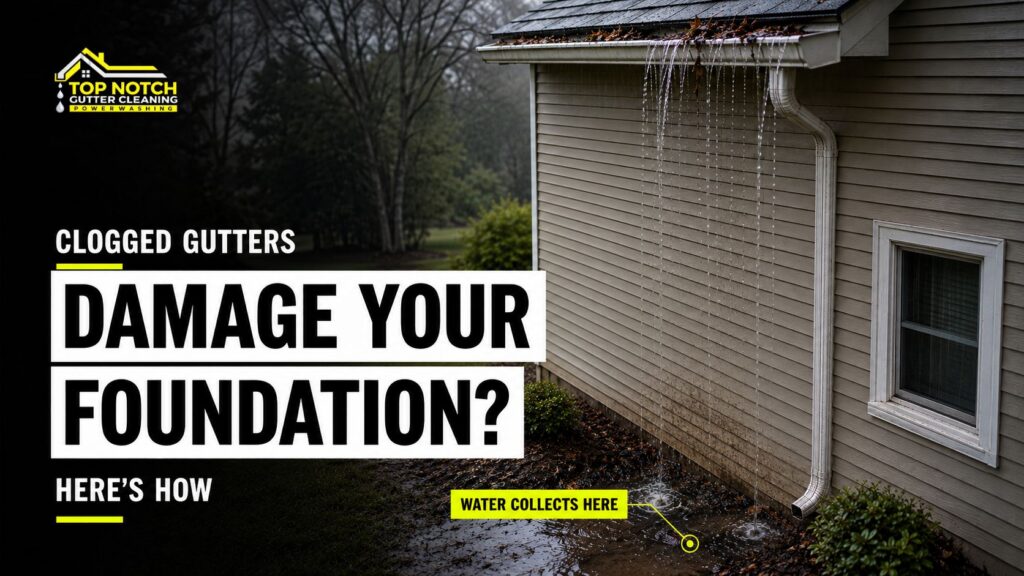
Yes, clogged gutters can damage your foundation by allowing roof runoff to spill beside your home instead of being carried safely away. Repeated gutter overflow can saturate or erode soil around the foundation, increase moisture pressure against below-grade walls, and contribute to leaks or movement over time.
That does not mean every foundation crack was caused by a gutter problem. But if water regularly pours over your gutters or collects beside the house after rain or snowmelt, the drainage problem deserves attention.
For homeowners around Denver, Highlands Ranch, Littleton, Parker, and Lakewood, this becomes especially worth checking after storms, leaf buildup, snow, or freezing weather.
Can Clogged Gutters Damage Your Foundation? Here’s How
A gutter system has a fairly simple job: collect roof runoff, move it into the downspouts, and discharge it somewhere that will not send the water back toward the house.
Once leaves, roof debris, dirt, or other material block that path, the water finds another route.
Usually, that means over the front or back edge of the gutter.
1. Water spills beside the house
Instead of reaching the downspout, water falls close to the foundation.
One overflowing section during one storm probably will not destroy a foundation. The bigger concern is repeated drainage failure in the same area.
2. The surrounding soil becomes saturated
Water collecting beside the house can make the soil wetter than it would be under normal drainage conditions.
The U.S. Department of Energy notes that large amounts of roof runoff can quickly saturate soil around a building when the water is not drained away properly.
3. Water pressure can build against below-grade walls
Hydrostatic pressure simply means pressure created by water.
When soil beside a basement or foundation wall stays saturated, that water can place additional pressure against the wall and make moisture intrusion through existing openings more likely. Building-science guidance specifically uses exterior drainage systems to reduce water saturation and pressure around foundations.
4. Concentrated runoff can wash away soil
Another problem is soil erosion around foundation areas.
If water continually dumps from the same overflowing gutter or downspout location, you may notice mulch moving, small channels forming in the soil, or bare areas appearing beside the home.
That loss of soil should not be ignored, particularly if the condition keeps returning.
In short: A clog does not attack the concrete itself. The problem is what happens to all the roof water when the gutter can no longer move it away from the house.
Signs Your Gutters May Be Sending Water Toward the Foundation
You do not need to wait until you see a structural problem.
Some of the earliest warning signs appear outside during or shortly after a storm.
Watch for:
- Water spilling over a gutter edge
- Puddles beside the foundation
- Very wet soil near a downspout
- Mulch or landscaping repeatedly washing away
- Small erosion channels beneath the roofline
- Gutters sagging or pulling away from the fascia
- Water marks on siding below the gutters
- A downspout that releases little or no water during rain
- Standing water remaining inside a gutter
- Dampness appearing in a basement or crawl space after storms
Competitor coverage consistently identifies overflow, pooling, erosion, sagging gutters, and basement dampness as common warning signs of drainage failure.
A simple rain test
The next time you get moderate rain and it is safe to go outside, look at the house from ground level.
Water should generally enter the gutters rather than running over their edges. It should then move through each downspout without obviously collecting right beside the home.
Do not climb onto a wet roof or ladder just to inspect a clog.
In short: If you can see water overflowing above and collecting below, you already know the drainage system is not doing its full job.
What Foundation Problems Can Poor Gutter Drainage Contribute To?
The key word here is contribute.
A foundation can develop problems for many reasons, including soil conditions, grading, construction details, plumbing leaks, groundwater, and structural movement. Clogged gutters are one possible source of excess water around the home, not an automatic explanation for every crack.
Potential drainage-related problems include:
Water pooling around foundation
Standing water is one of the clearest clues that runoff is not being carried far enough from the home.
The source might be a clog, damaged gutter, blocked downspout, poor grading, or a combination of those problems.
Basement water damage
Roof runoff that repeatedly saturates soil beside a basement can make moisture problems worse.
The EPA specifically notes that some basement moisture problems can be addressed by redirecting downspout runoff away from the foundation, although more extensive problems may require additional work.
Soil movement and erosion
Water concentrated in one place may wash soil away, while persistent saturation can change how some soils behave around the structure.
You do not need to diagnose the soil yourself. Repeated erosion is enough reason to correct the drainage source.
Existing cracks that stay wet
If a foundation already has openings, placing additional water against them is not helpful.
A gutter professional can address the drainage system, but significant foundation cracks, bowing walls, settlement, or recurring interior water intrusion should be evaluated by an appropriate foundation, structural, or waterproofing professional.
In short: Fixing the gutter problem removes one preventable source of water. It does not replace a structural inspection when signs point to an existing foundation problem.
Why Colorado Weather Makes Gutter Drainage Worth Watching
Colorado gutters deal with more than autumn leaves.
The local service environment can include rain, snow, ice, hail, debris, and changing temperatures, all of which can affect a gutter system or expose an existing drainage problem. Top Notch Gutter Services specifically installs and maintains gutter systems for these Colorado conditions.
A gutter that was partially blocked before a storm may overflow once runoff increases.
Debris left through colder weather can also interfere with drainage as snow or ice melts.
That is why Colorado gutter maintenance should focus on water flow, not simply whether the gutter looks clean from the ground.
Pay attention after:
- Heavy rain
- Strong wind that drops leaves or roof debris
- Major leaf fall
- Snowmelt
- Ice buildup
- Hail or storms that may loosen gutter components
Homes with large trees near the roofline may need inspections more often than homes with little surrounding vegetation.
Cleaning, Repair, or Replacement: What Does Your Gutter Actually Need?
Not every overflowing gutter needs replacing.
Sometimes the correct fix is simply removing the obstruction. In other cases, cleaning will not solve the underlying problem.
What you notice | Likely next step | Why |
Leaves and debris blocking an otherwise sound gutter | Gutter cleaning | Restores the intended water path |
Downspout has weak or no flow | Downspout cleaning | A blockage may be trapping water upstream |
One section leaks, sags, or has loose hardware | Gutter repair | The system may still be serviceable |
Water keeps overshooting or overflowing despite clean gutters | Inspection | Slope, capacity, placement, or roof runoff may need evaluation |
Multiple sections are deteriorated or repeatedly failing | Gutter replacement | Repeated spot repairs may no longer address the system as a whole |
Foundation cracks or major interior water problems are already present | Foundation/waterproofing evaluation plus gutter inspection | The drainage source and existing damage may both need attention |
When cleaning makes sense
Choose gutter cleaning when the gutter itself is in usable condition but leaves, dirt, pine needles, roof granules, or other material are restricting flow.
Cleaning should include checking the downspouts, because a gutter can look clear while a blockage lower in the system still prevents proper drainage.
When repair makes more sense
Consider gutter repair when there are loose sections, leaks, poor connections, detached downspouts, or isolated areas that no longer drain correctly.
Removing debris from a physically damaged gutter only solves half the problem.
When replacement may be reasonable
Replacement is worth discussing when deterioration is widespread or the system continues to fail despite cleaning and repair.
A professional should be able to explain why replacement is being recommended rather than treating every clog as an installation opportunity.
In short: Clean a blockage, repair a localized failure, and consider replacement when the existing system itself can no longer manage water reliably.
How Far Should Downspouts Carry Water From the House?
Cleaning the gutter is only part of the drainage equation.
A perfectly clear gutter can still create a problem if its downspout dumps roof runoff directly beside the foundation.
U.S. Department of Energy building guidance commonly uses at least five feet from the foundation as a benchmark for above-ground downspout discharge, with site-specific drainage systems sometimes carrying water farther.
That does not mean every property should use the exact same layout. Grade, neighboring properties, sidewalks, drainage systems, landscaping, and local requirements can affect where the water should go.
The EPA also advises homeowners to consider where redirected water will end up so that solving one runoff problem does not create another.
How to Reduce the Risk of Gutter-Related Foundation Problems
Prevention is mostly about keeping water predictable.
Keep the gutter channels open
Schedule gutter maintenance before debris becomes dense enough to block normal flow.
For many properties, spring and fall are logical inspection points, but homes surrounded by trees may need more frequent attention.
Check the downspouts too
A clean horizontal gutter with a clogged downspout still cannot drain correctly.
After cleaning, the system should be checked for clear water flow.
Watch where the water exits
Look for water returning toward the home, cutting channels through landscaping, or creating puddles beside the foundation.
Correcting the discharge point can be just as important as clearing the roofline.
Inspect after storms
Walk around the property once conditions are safe.
A two-minute ground-level check can reveal overflow, loose downspouts, new erosion, or standing water before those conditions repeat through several storms.
Do not ignore recurring overflow
If you clear the gutter and the same section still overflows, stop assuming debris is the only problem.
The gutter may have a slope, capacity, installation, or damage issue that deserves inspection.
When Should You Call a Gutter Professional?
You probably do not need professional help because you saw one leaf in the gutter.
Call for an inspection when the drainage failure is persistent, difficult to access safely, or appears to involve physical damage.
Professional service makes particular sense when:
- Water repeatedly pours over the same section
- A downspout remains blocked
- Gutters are high or difficult to reach safely
- Sections are sagging or detached
- You see repeated erosion beside the home
- Water collects at the foundation after storms
- Cleaning does not restore normal drainage
- You are unsure whether the system needs gutter repair or gutter replacement
Top Notch Gutter Services provides residential and commercial gutter cleaning, downspout clearing, repair, installation, and seasonal services throughout Denver and nearby communities. The company states that it is licensed and insured and serves Denver, Highlands Ranch, Littleton, Parker, and Lakewood.
For homeowners specifically looking for gutter cleaning Denver CO or gutter cleaning Highlands Ranch, addressing drainage before repeated overflow develops is far easier than waiting for visible water problems around the house.
FAQs
Yes. Clogged gutters can cause foundation problems indirectly when overflowing roof water repeatedly saturates or erodes soil beside the foundation.
A clog is not the only possible cause of foundation trouble, so existing structural symptoms should be evaluated separately.
The main pathway is poor drainage.
Water overflows near the home, saturates or erodes surrounding soil, and may increase moisture pressure against foundation or basement walls.
Overflowing gutters can contribute to foundation cracks by increasing repeated water exposure and changing moisture conditions around the foundation.
However, cracks have many possible causes, so you should not assume the gutter is responsible without an appropriate inspection.
Yes, clogged gutters can cause basement leaks or worsen an existing moisture problem if overflowing water repeatedly collects beside basement walls.
The EPA identifies redirecting downspout runoff away from the foundation as one possible way to address certain basement moisture problems.
Signs that deserve attention include gutter overflow, standing water against the house, eroded landscaping, damp basement areas, loose gutters, and recurring water marks below the roofline.
Serious cracks, wall movement, or structural changes should be assessed by a qualified foundation or structural professional rather than diagnosed solely as a gutter issue.
There is no perfect schedule for every property.
Spring and fall are useful starting points for Colorado gutter maintenance, but homes with nearby trees, frequent debris, storm exposure, or recurring clogs may need additional inspections or cleaning.
Gutter guards can reduce the amount of debris entering a system, but they do not eliminate the need to inspect the gutters and downspouts.
Water still needs a clear path from the roof to an appropriate discharge point away from the home.
Protect the Foundation by Fixing Drainage Problems Early
So, can clogged gutters damage your foundation? Yes. The risk comes from allowing roof runoff to repeatedly overflow, collect beside the house, erode soil, or keep the ground around the foundation wetter than it should be.
The practical response is not to panic over every clog. Watch how your system behaves during rain, keep the gutters and downspouts clear, correct damaged sections, and investigate repeated water pooling around foundation areas instead of ignoring them.
If your gutters are overflowing, blocked, sagging, or no longer carrying water properly, Top Notch Gutter Services can inspect the system and determine whether gutter cleaning, downspout cleaning, gutter repair, or replacement is the sensible next step.
Call Top Notch Gutter Services or request a free quote to schedule gutter service in Denver, Highlands Ranch, Littleton, Parker, Lakewood, or nearby Colorado communities.

 ICONIER Digital Agency