
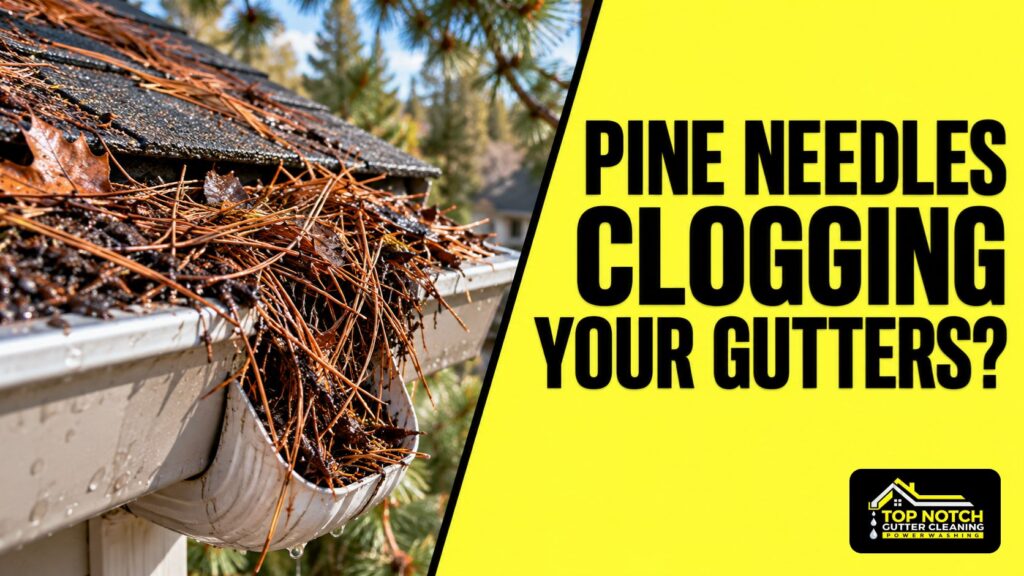
Pine needles clog gutters quickly because they are thin enough to enter small spaces, long enough to interlock with one another, and light enough to be carried across roofs by wind. Once they reach a gutter, they can catch leaves, roof grit, dust, and other debris until a loose handful becomes a dense blockage around the gutter or downspout outlet.
The problem can be especially frustrating around Denver-area properties with mature evergreens. Unlike one large autumn leaf drop, pine debris can reach the roof at different times of year, which means a gutter that was recently cleaned can start collecting needles again sooner than expected.
Why do pine needles clog gutters differently from leaves?
Their shape is the biggest reason.
A broad leaf usually sits on top of other debris until it becomes wet and begins breaking down. A pine needle can slide into narrow openings, lie lengthwise in the gutter, lodge across an outlet, or tangle with dozens of other needles.
Think of a handful of drinking straws dropped into a narrow channel.
One straw does little. Add enough of them at different angles, then mix in grit and leaves, and water has fewer open paths through the pile.
Pine needles can also lodge in:
- Gutter corners
- Gutter outlets
- Downspout elbows
- Roof valleys
- Guard openings
- Spaces around fasteners
In short: Pine needle gutter clogs form because needles do not need to fill a gutter to begin restricting water.
Why can the problem return so quickly?
Many deciduous trees have a more obvious seasonal leaf drop. Evergreens can contribute needle debris over a much longer period.
Wind makes the problem less predictable.
Needles do not have to fall directly into a gutter. They may land farther up the roof, collect in valleys, and later move toward the eave during wind, rain, or melting snow.
That means the gutter receives debris from more than the branches immediately above it.
A clean gutter can therefore start filling again from roof valley debris that was already sitting higher on the roof.
In short: The debris source is often the whole roof surface, not just the gutter opening.
What happens after pine needles get wet?
Dry pine needles are relatively loose.
Once moisture, dust, roof grit, seeds, and leaf fragments enter the gutter, the mixture can become much denser.
Water carries the smaller material into the spaces between the needles. The debris settles, more material lands on top, and the mass begins restricting drainage.
This is why a gutter may look as though it contains only a shallow layer of debris but still overflow during a storm.
The most troublesome location is often the outlet.
It does not take a gutter filled to the top to cause trouble if enough debris has accumulated directly above the downspout opening.
Can pine needles clog downspouts too?
Yes. Can pine needles clog downspouts? Absolutely.
The entrance to the downspout is one of the narrowest and most important points in the entire drainage system.
Needles can bridge across the outlet and catch additional debris. Smaller material can also enter the downspout and collect at elbows or other constricted areas.
Common signs of clogged downspouts include:
- Water standing in the gutter after rain
- Overflow close to a downspout
- Very little water exiting the bottom
- Water spilling from gutter seams or corners
- A downspout that sounds or behaves differently from the others
A gutter cleaning that removes visible material but leaves the downspout blocked is only half of the job.
In short: Keeping the outlet and downspout open is just as important as clearing the gutter trough.
Why Denver-area homes can be especially vulnerable
Homes across Denver, Highlands Ranch, Littleton, Parker, and Lakewood do not all have the same tree coverage, but properties near mature evergreens can face recurring pine needles in gutters.
Colorado weather can compound the issue.
Wind moves lightweight needles across the roof. Rain sends roof debris toward gutters. Melting snow can carry smaller material into outlets. When temperatures fall, moisture trapped inside existing debris can freeze.
The result is a drainage system that may face different versions of the same problem throughout the year.
For tree-heavy properties, maintenance should therefore be based on actual debris accumulation rather than a rigid “twice a year works for everyone” schedule.
How often should gutters near pine trees be cleaned?
There is no universal schedule.
Start with spring and fall checks, then increase the frequency if the property accumulates needles faster than the gutter can safely handle.
A home may need more attention when:
- Pine branches extend over the roof.
- Needles collect heavily in valleys.
- Gutters have long runs with limited outlets.
- Downspouts clog repeatedly.
- The home has difficult-to-see upper gutters.
- Overflow appears between scheduled cleanings.
- A major wind event deposits unusual debris.
A practical maintenance schedule is based on evidence from the property itself.
If the same gutter is repeatedly full after a few months, waiting another six months because the calendar says “twice yearly” makes little sense.
In short: Seasonal gutter maintenance should follow the debris load around the home.
Do gutter guards stop pine needles?
The right system can reduce how many needles enter a gutter, but gutter guards should not be treated as zero-maintenance equipment.
The opening size matters.
A coarse screen may stop broad leaves but still allow narrow needles to pass through or lodge in the openings. Finer systems can block smaller debris more effectively, but needles and other material may still collect on top.
That surface buildup occasionally needs attention so water can reach the gutter.
The existing gutter also needs to work correctly before a guard is installed. Covering a sagging, poorly pitched, or partially blocked gutter does not correct the underlying problem.
What gutter guards work for pine needles?
For homeowners researching what gutter guards work for pine needles, fine-screen or micro-mesh gutter guards are often considered because their openings are smaller than those of many basic screens.
But mesh size is not the only thing to compare.
Ask:
- How does the system handle pine needles?
- Can debris sit on the upper surface?
- How is that surface maintained?
- Will the guard fit the existing gutter correctly?
- Does installation interfere with the roof edge?
- Can the guard handle runoff from nearby valleys?
- Can the gutter still be inspected and serviced later?
No guard should be sold as a reason to ignore the gutter indefinitely.
A good gutter guard installation reduces debris entry while leaving you with a system that can still be checked and maintained.
Cleaning or guards: which solution makes more sense?
The answer depends on how frequently the clogs return.
Situation | More practical starting point |
Light seasonal pine debris | Routine gutter cleaning |
One problem gutter near a tree | More frequent targeted cleaning |
Heavy recurring needle accumulation | Evaluate pine-compatible guards |
Existing damaged or sagging gutter | Repair before adding guards |
Downspout repeatedly blocks | Clear and evaluate the outlet/downspout |
Heavy roof-valley accumulation | Address the valley and gutter together |
For some homeowners, professional gutter cleaning Denver services once or twice at the right times are simpler than adding a guard.
For a property surrounded by evergreens where needles return constantly, gutter guards for pine needles may reduce the maintenance burden.
The right answer depends on the roof and trees.
In short: Solve the actual debris problem instead of automatically buying the most complicated solution.
How do I keep pine needles out of gutters?
If you are asking How do I keep pine needles out of gutters?, focus on several layers rather than a single fix.
- Keep gutters and outlets clear.
- Clean problem areas before debris becomes densely packed.
- Include downspouts in the cleaning.
- Pay attention to roof valleys.
- Inspect after periods of heavy wind.
- Repair sagging or poorly draining sections.
- Consider pine-compatible gutter guards when repeated cleaning becomes excessive.
- Continue inspecting guarded gutters.
Homeowners should also avoid climbing onto steep or icy roofs solely to inspect debris. Many drainage issues can first be identified safely from the ground and then checked by a properly equipped service provider.
Signs pine needles are already affecting drainage
You do not have to see a gutter filled to the brim before taking action.
Watch for:
- Water overflowing in one concentrated area
- Dark staining below gutters
- Plants or soil being washed directly below the eave
- Standing water in the gutter
- Downspouts with weak flow
- Needles protruding from outlets
- Sagging caused by retained wet debris
- Ice developing around a debris-filled gutter in winter
Recurring overflow is especially useful information because it tells you where to inspect first.
A photo or short video taken safely from ground level during rain can help show whether the issue is a gutter clog, outlet problem, overshooting runoff, or another drainage condition.
Frequently Asked Questions
Their narrow shape allows them to reach places broad leaves cannot. Once inside, they tangle with other debris and can block outlets.
Needle drop varies by tree species, season, weather, and property. Homes close to mature evergreens can receive debris outside the normal autumn leaf-cleaning period.
No. Gutter guards for pine needles can substantially reduce debris entry when properly selected, but no system should be assumed to eliminate inspection and maintenance.
Micro-mesh gutter guards use smaller openings than many traditional screens, which can make them better suited to fine debris. The complete installation and ongoing surface maintenance still matter.
Yes, when they are collecting debris. Valleys can deliver large amounts of needles directly into one short gutter section.
Needles themselves are mainly a clogging problem. The retained debris and water can add weight, restrict drainage, and contribute to conditions that stress gutters and fasteners.
Consider professional service when gutters are high, difficult to access, repeatedly clogged, overflowing, or paired with blocked downspouts. Avoid unsafe ladder or roof work.
Stop recurring pine-needle clogs before they block drainage
The reason pine needles clog gutters so quickly is not simply that there are a lot of them. Their shape allows them to enter narrow spaces, interlock with one another, trap smaller debris, and collect around the outlets that control the whole system.
Regular cleaning remains the simplest solution for many homes. When needles return constantly, properly selected gutter protection may make maintenance easier without pretending that gutters will never need attention again.
Top Notch Gutter Services provides gutter cleaning, downspout cleaning, repairs, gutter guard installation, and seasonal maintenance for homeowners throughout Highlands Ranch, Denver, Littleton, Parker, Lakewood, and nearby Colorado communities.
If pine needles keep filling your gutters or blocking your downspouts, call Top Notch Gutter Services or request a free quote to have the drainage system cleaned and evaluated.

 ICONIER Digital Agency