
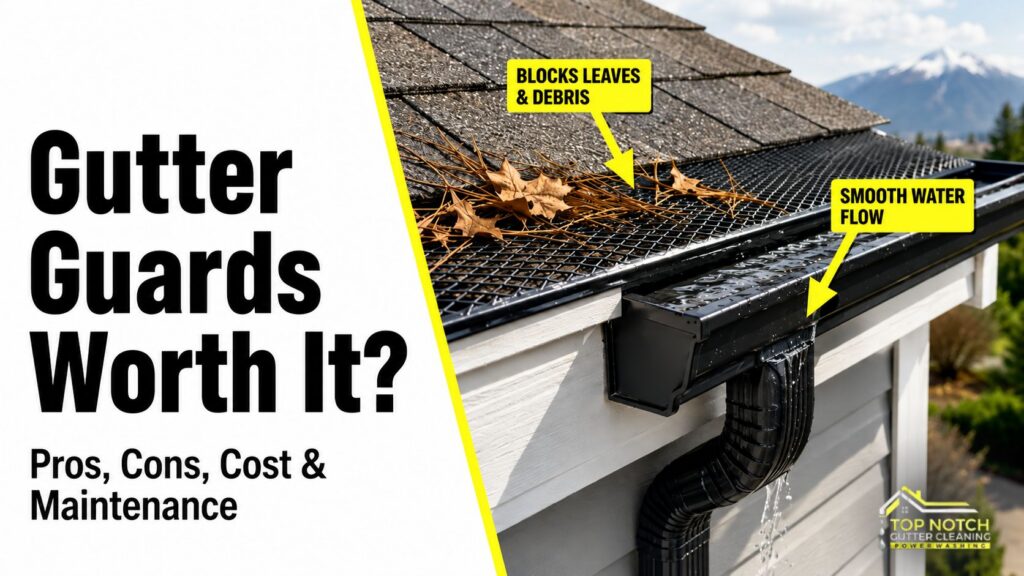
Yes, gutter guards for Denver homes are often worth it if your gutters clog often, your home sits near trees, or you want to reduce risky ladder cleanings. They are not a magic fix, though. If your gutters are sagging, undersized, leaking, or pitched the wrong way, guards can hide the real problem instead of solving it.
For many homeowners in Denver, Highlands Ranch, Littleton, Parker, and Lakewood, the right guard system can reduce clogs from leaves, pine needles, cottonwood fluff, roof grit, and wind-blown debris. But the word “reduce” matters. Even good guards still need inspection and light cleaning from time to time.
Quick answer: Are gutter guards for Denver homes worth it?
Gutter guards for Denver homes are worth considering when your home has repeated clogs, mature trees nearby, steep rooflines, hard-to-reach gutters, or drainage problems during heavy rain and snowmelt. They are less useful when the gutter system itself is damaged or poorly designed.
A good guard acts like a filter. Water should enter the gutter while leaves, needles, and larger debris stay out. That helps protect the roof edge, siding, landscaping, and foundation from overflow.
But no guard should be sold as “install it and forget it.” Denver weather brings wind, freeze-thaw cycles, snow, hail, spring debris, and roof sediment. Those conditions can still leave buildup on top of guards or near downspouts.
In short: gutter guards for Denver homes are worth it when they are matched to the roof, debris type, gutter condition, and local weather. They are not worth it when they are used as a shortcut for needed gutter repair or gutter replacement.
Why Denver homes have different gutter guard needs
Denver-area homes deal with more than simple fall leaves. A house in Highlands Ranch with pine trees has different gutter problems than a Littleton home with cottonwoods or a Parker property exposed to open wind.
Common Denver-area gutter problems include:
- Pine needles slipping through cheap screens
- Cottonwood seed buildup in spring
- Roof grit collecting after hail or aging shingles
- Heavy runoff during fast snowmelt
- Ice forming near shaded roof edges
- Wind-blown leaves landing on roofs and valleys
- Downspouts clogging where debris settles at elbows
The National Weather Service lists Denver’s long-term average seasonal snowfall at 56.6 inches, and snowfall can be higher in western and southwestern suburbs. That matters because gutters must handle both storms and melting snow, not just rain.
This is why Colorado gutter protection should not be chosen by price alone. The cheapest cover may block leaves but fail with needles, grit, or winter buildup.
In short: Denver homes need gutter guards that handle small debris, snowmelt, wind, and changing temperatures. A basic screen may work for some homes, but it is not the right answer for every roof.
Pros of gutter guards for Denver homeowners
The main benefit of gutter guard installation is fewer serious clogs. When water can move through the gutter and downspout, the home has a better chance of avoiding overflow near the roofline and foundation.
1. Less frequent gutter cleaning
Good guards can reduce how often you need gutter cleaning. That is helpful for two-story homes, steep rooflines, rental properties, and homeowners who do not want to climb ladders.
You may still need seasonal inspections, but there is usually less heavy debris to scoop out.
2. Better water flow during storms
Blocked gutters can spill water over the front edge. That water can splash against siding, wash out mulch, pool near the foundation, or freeze along walkways.
When guards work properly, rainwater and snowmelt have a clearer path into the gutter system.
3. Helps protect downspouts
A gutter guard is only useful if the water can exit through the downspouts. By keeping larger debris out of the gutter trough, guards can reduce the chance of clogged elbows and buried drain connections.
That said, downspout cleaning is still important. If the downspout is already packed with leaves, guards will not fix the backup.
4. Helpful for homes near trees
Homes near pine, ash, maple, cottonwood, and mature shade trees often need more frequent cleaning. Micro-mesh gutter guards can be a better fit for fine debris because they block smaller material than basic screens.
5. Can support long-term gutter performance
Standing debris holds moisture. Over time, that can speed up rust, staining, and joint problems, especially on older systems.
Guards can help reduce that buildup, but only if the gutters are cleaned and inspected before installation.
In short: The biggest value is not “never clean again.” The real value is fewer clogs, safer upkeep, cleaner water flow, and less emergency maintenance.
Cons of gutter guards: homeowners should know first
The biggest mistake is thinking guards solve every drainage issue. They do not.
1. They cost more upfront
Professional gutter guard installation can be a real investment. Denver cost guidance commonly places installation around $6 to $14 per linear foot, with total project cost depending on home size, guard type, roof access, and existing gutter condition.
A small ranch home may cost much less than a large two-story home with steep rooflines and multiple corners.
2. They are not maintenance-free
Do gutter guards need cleaning? Yes, sometimes. Debris can sit on top of the guards, roof grit can collect in the mesh, and downspouts can still need attention.
A fair expectation is reduced maintenance, not zero maintenance.
3. Cheap guards can create new problems
Low-cost foam, brush, or plastic covers can trap debris, shift out of place, or struggle with small particles. Some systems also make cleaning harder if they must be removed to access the gutter.
4. Snow and ice still need attention
Do gutter guards work with snow and ice? They can help by keeping debris out of the water path, but they do not stop ice dams by themselves.
Ice issues often come from attic insulation, ventilation, roof temperature, shade, and freeze-thaw patterns. If your home already has ice dam problems, guards should be part of a bigger inspection, not the only solution.
5. They will not fix bad gutters
If your gutters are loose, leaking, undersized, or sloped incorrectly, guards may make the issue harder to see. In that case, gutter repair, seamless gutter installation, or gutter replacement may be the better first step.
In short: Guards can reduce clogs, but they cannot fix poor drainage design, damaged gutters, or roof-related ice problems.
How much do gutter guards cost in Denver?
Gutter guard cost in Denver depends on the guard material, linear footage, number of stories, roof pitch, gutter condition, and whether cleaning or repairs are needed first.
A Denver cost guide places professional installation at about $6 to $14 per linear foot, with a typical project range from about $930 to $2,126. Larger homes, specialty guard types, repairs, and difficult access can raise the price.
Here is a practical cost comparison:
Option | Typical fit | Cost level | Maintenance level | Best for |
Basic screen guards | Larger leaves | Low | Medium | Budget protection with light tree cover |
Brush guards | Larger debris | Low to medium | High | Short-term or easy-access gutters |
Foam inserts | Light debris | Low to medium | Medium to high | Simple DIY use, not ideal for heavy debris |
Reverse curve guards | Leaves and rain flow | Medium to high | Low to medium | Homes with larger debris and a proper roof fit |
Micro-mesh gutter guards | Fine debris, needles, grit | Medium to high | Low to medium | Denver homes near trees or roof grit |
Do not choose based on price only. A lower-cost guard that clogs with pine needles can cost more later through cleaning, removal, or replacement.
In short: The right gutter guard cost depends on your roof and debris problem. A written estimate after inspection is more useful than a flat online price.
Best gutter guard types for Denver-area homes
Not every guard type performs the same. The best choice depends on what is clogging your gutters.
For pine needles and fine debris
Micro-mesh gutter guards are usually the better option for pine needles, cottonwood fluff, small leaves, and roof grit. The fine mesh blocks more debris than standard screens.
They do need occasional brushing or rinsing if grit settles on top.
For larger leaves
A quality metal screen or reverse-curve guard may work when the main issue is larger leaves. These can be useful for some homes in Lakewood, Littleton, and older Denver neighborhoods with mature trees.
For budget situations
Foam and brush guards may look attractive because of the lower price. But they can trap debris inside the gutter channel and may require more frequent removal and cleaning.
For many Denver-area homes, they are better viewed as short-term protection, not a long-term system.
For older gutters
If your gutters already leak, sag, overflow at corners, or pull away from fascia, guards should wait. Start with gutter repair or gutter replacement.
A clean, correctly pitched gutter is the base of any good guard system.
In short: For Denver debris, micro-mesh gutter guards are often the most practical option, especially around pine needles and roof grit. But the gutter condition matters just as much as the guard type.
Gutter guards vs regular gutter cleaning
Some homeowners do not need guards. Regular gutter cleaning may be the smarter choice if your gutters only clog once or twice a year and are easy to access.
Here is a simple way to decide:
Situation | Better choice |
Gutters clog several times a year | Consider gutter guard installation |
One-story home with light debris | Seasonal gutter cleaning may be enough |
Pine needles or cottonwood fluff keep returning | Consider micro-mesh gutter guards |
Gutters are leaking or sagging | Start with gutter repair |
The old system overflows even when clean | Consider gutter replacement or larger downspouts |
Commercial building or rental property | Guards plus scheduled maintenance may save time |
The shaded roof has ice problems | Inspect the roof, insulation, and drainage first |
Professional cleaning is also useful before any guard installation. Installing guards over dirty gutters traps the problem inside.
In short: Guards are not always the first step. Clean first, inspect second, then decide whether guards, repairs, or new gutters make the most sense.
Maintenance after gutter guard installation
Good guards reduce work, but they still need care. The goal of gutter guard maintenance is to keep water moving freely.
A simple Denver-area maintenance plan looks like this:
- Inspect in spring after snow, wind, and early tree debris.
- Check again in the fall after the leaves drop.
- Look for debris sitting on top of guards.
- Make sure water exits every downspout.
- Watch for overflow during the next heavy rain.
- Check shaded roof edges for winter ice buildup.
- Schedule cleaning if water slows down or spills over.
For homes near trees, a yearly inspection is smart. For homes with heavy pine needles, cottonwood seeds, or roof grit, twice a year may be better.
Top Notch Gutter Services offers gutter cleaning, downspout cleaning, gutter repair, gutter replacement, and gutter installation services across Denver, Highlands Ranch, Littleton, Parker, and Lakewood. The company states that it is licensed and insured, locally operated, and provides upfront estimates.
In short: Guards reduce the mess, but they still need checkups. A small maintenance visit can prevent overflow, hidden clogs, and winter drainage problems.
When gutter guards are not worth it
There are times when leaf guard installation is not the right move.
Skip gutter guards for now if:
- Gutters are pulling away from the fascia
- Water already spills over clean gutters
- Downspouts are too small or poorly placed
- Sections are rusted, cracked, or bent
- The roofline sends too much water into one short run
- You plan to replace the roof soon
- You only have light debris and easy access
- You expect zero maintenance forever
In those cases, start with a proper inspection. Sometimes the answer is downspout cleaning. Sometimes it is adding a larger outlet, correcting pitch, sealing joints, or replacing old sections.
If the whole system is outdated, seamless gutter installation may be a better long-term upgrade than adding guards to weak gutters.
In short: Do not put guards on a failing system. Fix the gutter first, then protect it.
How to choose a gutter guard installer in Denver
A good installer should inspect before quoting. They should look at your roofline, trees, gutter size, downspouts, fascia condition, roof pitch, and problem areas.
Before hiring for gutter guards Denver service, ask:
- What type of debris is causing my clog?
- Do my gutters need cleaning before installation?
- Are my gutters properly pitched?
- Do any downspouts need to be cleared or upgraded?
- What guard type fits my roof and tree coverage?
- How is the guard attached?
- Will the system affect roof shingles or drainage?
- What maintenance will still be needed?
- Is the estimate written and itemized?
A good answer should be specific to your home. Be careful with anyone who says every home needs the same guard or that no maintenance will ever be needed.
Top Notch Gutter Services provides local gutter services Denver homeowners can use before deciding, including cleaning, repair, replacement, and installation support.
In short: The right installer should diagnose the drainage problem first. The guard is the solution only after the cause is clear.
FAQs
Yes, gutter guards for Denver homes can be worth it if your gutters clog often, your home has nearby trees, or cleaning is risky due to height or roof access. They are less useful if your gutter system needs repair first.
Gutter guard cost often depends on linear footage, material, roof height, access, and gutter condition. Denver cost guidance commonly lists professional installation at around $6 to $14 per linear foot, with total project cost varying by home.
Yes. Gutter guard maintenance may include brushing debris off the top, rinsing fine grit, checking corners, and making sure downspouts drain properly. They reduce cleaning, but they do not remove it completely.
They can help keep debris from blocking snowmelt, but they do not fully prevent ice dams. Ice problems may also involve roof heat loss, attic ventilation, insulation, shade, and freeze-thaw cycles.
Micro-mesh gutter guards are usually better for pine needles, cottonwood fluff, shingle grit, and small debris because the openings are finer than basic screens.
Yes. Absolutely. Installing guards over dirty gutters can trap leaves, mud, and roof grit inside the system.
Sometimes. If your home has light debris, easy access, and only needs cleaning once or twice a year, scheduled gutter cleaning may be more cost-effective than installing guards.
Are gutter guards for Denver homes the right choice?
Gutter guards for Denver homes are worth it when they solve a real clogging problem, match the debris around your property, and are installed on gutters that already drain correctly. They are not worth it when they are used to cover up leaks, sagging sections, poor slope, or undersized downspouts.
For many Denver-area homeowners, the smartest path is simple: clean the gutters, inspect the system, repair what is weak, then decide whether guards make sense.
If you are dealing with clogs, overflow, pine needles, snowmelt issues, or hard-to-reach gutters, Top Notch Gutter Services can inspect your gutter system and recommend the right next step.
Call now, schedule service, or request a free quote for honest local help in Denver, Highlands Ranch, Littleton, Parker, and Lakewood.

 ICONIER Digital Agency