
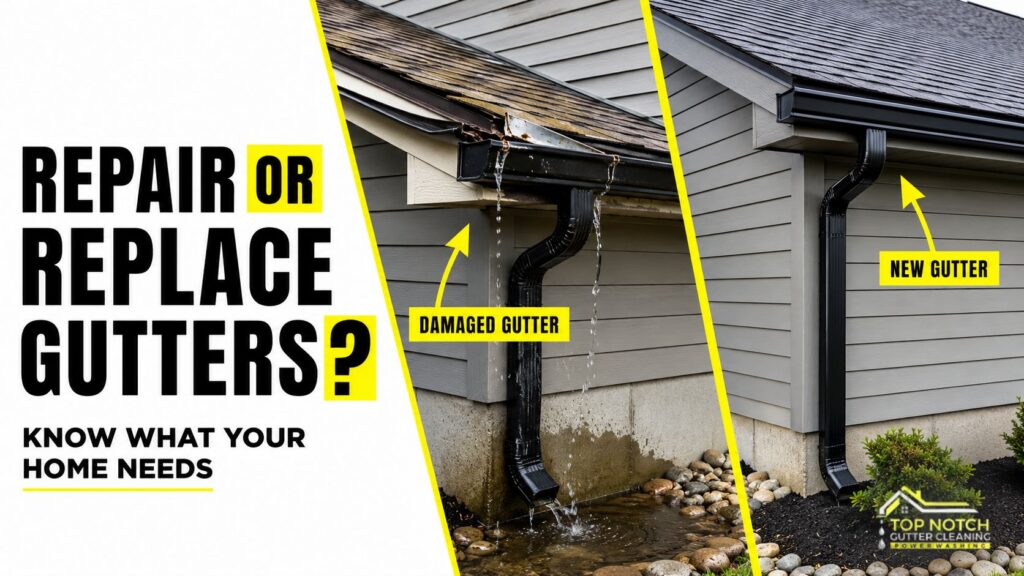
You should repair or replace gutters based on how serious the damage is, where it is located, and whether the problem keeps coming back. Small leaks, one loose section, or a minor clog often point to gutter repair or gutter cleaning. Widespread rust, sagging runs, repeated leaks, poor drainage, or water near the foundation usually mean gutter replacement is the smarter choice.
For homeowners in Highlands Ranch, Denver, Littleton, Parker, Lakewood, and nearby Colorado communities, this decision matters because gutters deal with more than rain. Snow, ice, hail, pine needles, leaves, and fast temperature swings can all expose weak spots in an older gutter system.
Top Notch Gutter Services helps homeowners look at the full picture: the gutters, downspouts, roofline, fascia, drainage path, and signs of water damage around the home. This guide will help you understand what to check before scheduling service.
When to Repair or Replace Gutters: The Simple Rule
The easiest way to decide is this:
Repair your gutters when the problem is small and isolated, and the rest of the system is still in good shape. Replace them when the damage is widespread, structural, or causing water to go where it should not.
A single leaking corner is not the same as a whole gutter run pulling away from the roofline. A blocked downspout is not the same as a gutter system that has the wrong pitch. That is why a quick look from the ground does not always tell the full story.
Think of your gutter system as one drainage path. Water should move from the roof, into the gutter, through the downspout, and away from the home. If one part of that path is blocked or broken, a repair may solve it. If the entire path is failing, replacement may save you from paying for one patch after another.
In short: choose gutter repair for small, contained issues. Choose gutter replacement when the system no longer moves water away from your home reliably.
Signs Your Gutters May Only Need Repair
Not every gutter problem means you need a new system. In many homes, especially when the gutters are not very old, a targeted repair can bring water flow back to normal.
You may only need gutter repair if you notice the following:
- One leaking seam or corner
- A short section pulling loose
- A few missing or bent hangers
- A small crack or hole in one area
- One downspout is blocked
- Minor storm damage in a single section
- Overflow caused by clogged gutters, not broken gutters
A good example is a gutter that overflows only above one porch or garage corner. If the rest of the home drains correctly, the issue may be packed debris, a clogged elbow, or a small pitch problem. That is usually a repair or cleaning job, not a full replacement.
Another repair-friendly situation is a loose hanger. If the fascia board behind it is solid and the gutter itself is not bent badly, a technician may be able to refasten that section and restore the slope.
Can leaking gutters be repaired? Yes, many leaks can be repaired if they come from one seam, one corner, or one damaged section. If leaks appear in several places or the metal is thin and worn, replacement may be a better long-term decision.
In short: if the damage is small and the rest of the system still works, repair first.
Signs Your Home May Need Gutter Replacement
Some gutter problems are not worth chasing with repeated repairs. If the system is old, loose, dented, rusted, undersized, or poorly pitched, repairs may only buy a little time.
You may need gutter replacement if you notice:
- Long sections sagging or pulling away
- Gutters that keep separating at the joints
- Rust or holes in many areas
- Water spilling behind the gutters
- Fascia boards that look soft or rotted
- Gutters bent from hail, ladders, or falling branches
- Standing water inside the gutter after rain
- Water is pooling around the foundation
- Soil erosion below the roof edges
- Basement dampness or stains near exterior walls
- Repairs that fail again after every storm
The biggest warning sign is repeated failure. If you fix one leak in spring, another in summer, and another after the first snow, your gutters may be telling you they are past their useful life.
When should gutters be replaced? Gutters should be replaced when they cannot hold the correct slope, stay attached, drain through the downspouts, or keep water away from the roofline, siding, landscaping, and foundation.
In short: replace gutters when the problem is no longer in one spot. A failing system costs more when you keep treating it like a small repair.
Repair vs Replacement: Quick Comparison Table
Use this table as a homeowner-friendly starting point. A professional inspection is still the safest way to confirm what your home needs.
Gutter problem | Repair may be enough | Replacement may be better |
One small leak | Yes, if the surrounding gutter is solid | If leaks appear in several areas |
Loose hangers | Yes, if the fascia is healthy | If hangers keep pulling out |
Overflow during rain | Yes, if caused by debris | If gutters are undersized or badly pitched |
Sagging section | Sometimes, if limited to one area | If long runs are sagging |
Rust or holes | Sometimes, if minor and isolated | If rust is spread through the system |
Hail dents | Sometimes, if drainage still works | If dents block water flow or damage long sections |
Water near the foundation | Maybe, if the downspout is clogged | If the drainage design is failing |
Old sectional gutters | Repair may help in the short term | Seamless gutter installation may reduce recurring joint leaks |
Is gutter replacement worth it? It can be worth it when repairs are becoming regular, water is reaching the foundation, or the gutter system no longer fits the home’s drainage needs. If the issue is only one small leak, repair is usually the more reasonable first step.
In short: repair solves a specific problem. Replacement solves a system problem.
Colorado Weather Makes the Decision More Important
Colorado gutters work hard. A home in Denver, Highlands Ranch, Littleton, Parker, or Lakewood can see heavy spring runoff, summer storms, hail, fall leaves, and winter freeze-thaw cycles.
That mix can make a weak gutter problem show up faster.
For example, a small pitch issue may not seem serious during light rain. But when snow melts off the roof and refreezes overnight, standing water in the gutter can become a bigger problem. A slightly loose section can pull farther away when it is weighed down by wet leaves or ice.
Hail can also dent gutters and downspouts. A shallow dent may be cosmetic. A deep dent can slow water flow, trap debris, or create a low spot where water sits.
For homes with nearby trees, seasonal gutter maintenance matters even more. Leaves, pine needles, seed pods, and roof grit can collect around outlets and elbows. That can make a healthy gutter look broken when it really needs cleaning and downspout cleaning.
In short: Colorado weather can turn small gutter problems into water problems quickly. Check gutters after hail, heavy wind, leaf drop, and snowmelt.
Check These Areas Before You Decide
Before you pay for gutter installation or approve a repair, look at the whole drainage system. Gutters are only one part of the job.
1. The gutter run
Look for sagging, bending, cracks, rust, gaps, or places where the gutter is pulling away from the fascia. From the ground, you may also notice water stains below one section.
2. The downspouts
Downspouts should move water away from the home, not dump it beside the foundation. If water backs up during rain, you may need downspout cleaning or a better drainage extension.
3. The fascia board
If the wood behind the gutter is soft, stained, or rotted, simply refastening the gutter may not hold. The gutter needs a solid surface behind it.
4. The roof edge
If water is running behind the gutter instead of into it, the issue may be placement, pitch, or a roof-edge detail. This is one reason a professional inspection is helpful.
5. The ground below
Look for washed-out mulch, trenches in soil, peeling paint near the base of walls, or water collecting near the foundation. These signs matter because gutters are supposed to protect more than the roof.
How do I know if my gutters are bad? Your gutters may be bad if they sag, leak in several places, overflow when cleaned, separate at joints, hold standing water, or allow runoff to collect near your foundation.
In short: do not judge gutters only by what you see at the front edge. Follow the water from the roof to the ground.
Where Gutter Cleaning Fits Into the Decision
Sometimes homeowners think they need gutter replacement when they actually need a proper cleaning. This is common after fall leaf drop or after a storm pushes debris into the system.
Clogged gutters can cause the following:
- Overflow during rain
- Water spilling over the front edge
- Water is backing up near the roofline
- Sagging from extra weight
- Downspouts that stop draining
- Water is collecting near the home
If the gutters are still straight, firmly attached, and not badly rusted, gutter cleaning may fix the problem. Cleaning should include debris removal, checking outlets, and clearing the downspouts so water can move freely.
This is especially useful for homeowners looking for gutter cleaning in Lakewood, Littleton, Denver, Parker, and nearby areas where mature trees can fill gutters quickly in the fall.
In short: clean first when the system looks solid, but water is overflowing. Replace only when the system itself is damaged or failing.
Should You Add Gutter Guards?
Gutter guards can help reduce how much debris that enters the system, especially on homes with trees close to the roof. They are not a magic fix, and they do not mean gutters will never need attention.
They may be worth considering if:
- Your gutters clog several times a year
- Leaves and pine needles collect quickly
- Downspouts block often
- You want to reduce cleaning frequency
- You are already planning gutter replacement
For some homes, gutter guards make the most sense during gutter installation because the system can be set up together. For other homes, cleaning and repair may be enough.
Be careful, though. If your gutters are already sagging, undersized, or badly pitched, adding guards will not solve the main problem. It may only hide it for a while.
In short: guards help with debris. They do not fix damaged gutters, bad pitch, loose fascia, or poor drainage design.
What a Professional Gutter Inspection Should Tell You
A good inspection should not pressure you into the most expensive option. It should explain what is happening, why it is happening, and what choices make sense.
For example, if you call for gutter repair in Denver, the inspection should look beyond the obvious leak. The technician should check whether the gutter is properly sloped, whether the downspout is clear, whether the hanger spacing is strong enough, and whether water is being moved away from the foundation.
For gutter replacement in Highlands Ranch or gutter installation in Parker, the inspection should also consider roofline shape, drainage volume, downspout placement, material options, and the look of the home.
A useful inspection should answer:
- Is the issue caused by debris, damage, poor slope, or age?
- Can the problem be repaired safely?
- Will the repair likely last?
- Are downspouts placed correctly?
- Is water draining far enough away from the home?
- Would replacement prevent repeat service calls?
- Are gutter guards worth adding for this property?
Top Notch Gutter Services provides Denver-area gutter services for homes and businesses, including cleaning, repair-related assessments, old gutter removal, and new gutter installation options.
In short: the right answer should be based on your home, not a one-size-fits-all recommendation.
How Top Notch Gutter Services Can Help
Top Notch Gutter Services works with homeowners and property owners who need practical help with damaged gutters, clogged downspouts, outdated systems, and seasonal maintenance.
The team serves Highlands Ranch, Denver, Littleton, Parker, Lakewood, and nearby Colorado communities. Services related to this topic include gutter cleaning, downspout cleaning, gutter replacement, gutter installation, old gutter removal, custom-fit gutter systems, and leaf guard options.
If your gutters are overflowing but still in good shape, cleaning or a small repair may be enough. If your gutters are sagging, leaking across multiple sections, or sending water toward the foundation, replacement may be the safer path.
The goal is simple: move water away from the home before it damages the roofline, siding, landscaping, or foundation.
In short: Top Notch Gutter Services can inspect the issue and help you decide whether repair, cleaning, guards, or replacement is the right next step.
FAQs
If the leak is in one seam, corner, or short section, gutter repair may be enough. If leaks are appearing in several areas, the system may be worn out or poorly pitched, and gutter replacement may make more sense.
Yes, leaking gutters can often be repaired when the damage is minor and localized. A technician may reseal a joint, refasten a loose section, clear a blockage, or replace a short, damaged run.
Gutters should be replaced when they sag, pull away, rust through, separate repeatedly, hold standing water, or continue causing drainage problems after cleaning and repairs.
Many homes benefit from cleaning in spring and fall, with extra checks after hail, wind, heavy leaf drop, or snowmelt. Homes with trees near the roof may need service more often.
No. Gutter guards can reduce leaves and larger debris, but fine debris, roof grit, pine needles, and ice can still create buildup. They help most when paired with a properly working gutter system.
Ignoring damaged gutters can allow water to spill near the siding, roof edge, landscaping, and foundation. Over time, that may lead to erosion, staining, basement moisture, or other water-related repairs.
For gutter services in Littleton, Denver, Highlands Ranch, Parker, Lakewood, and nearby Colorado communities, Top Notch Gutter Services can help with cleaning, inspections, repairs, replacement, and installation options.
Make the Choice Before Water Makes It for You
The decision to repair or replace gutters comes down to one honest question: Is this a small fix, or is the whole drainage system failing?
If the problem is one leak, one loose section, or a clogged downspout, repair or cleaning may be the right move. If the gutters are sagging, rusting, separating, or sending water toward your foundation, replacement may protect your home better over time.
Top Notch Gutter Services helps Colorado homeowners choose the option that fits the actual condition of the home.
Call now, get a free quote, or schedule service if you are unsure what your gutters need.

 ICONIER Digital Agency