
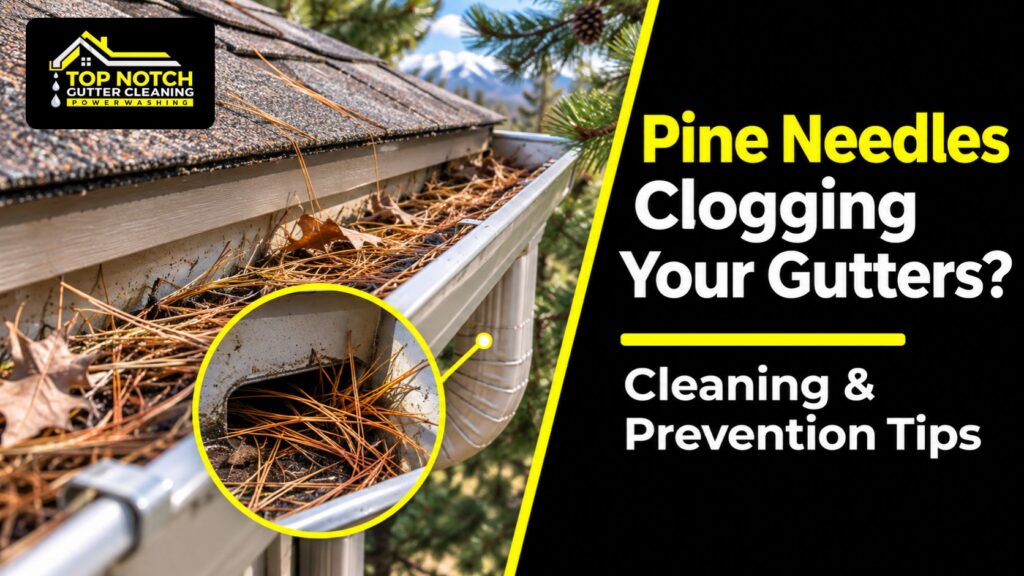
Pine needles clogging gutters is a recurring problem for Colorado homeowners because the narrow needles can slip into small openings, collect around gutter corners, and form dense blockages when mixed with leaves, dirt, and moisture. Unlike many broad leaves, pine needles can also become lodged in gutter screens and downspout outlets. The most effective solution combines thorough gutter and downspout cleaning, regular inspections, and appropriate gutter protection when necessary.
Homes in Highlands Ranch, Denver, Littleton, Parker, and Lakewood may experience this problem when mature evergreen trees grow near rooflines.
If you clean your gutters only to find them clogged with needles again a few weeks later, understanding where the debris comes from can help you choose a better maintenance approach.
Why Do Pine Needles Clog Gutters So Easily?
Pine needles behave differently from ordinary leaves.
Their long, thin shape allows them to enter spaces where larger debris might remain on the surface.
Once inside a gutter, needles can overlap, interlock, and collect additional material.
A few loose needles may not interfere with drainage. Problems develop when enough debris accumulates to restrict water flow.
Pine Needles Can Form Dense Debris Mats
Pine needles often collect in overlapping layers rather than remaining evenly distributed.
As rainwater moves through the gutter, smaller particles of dirt, roofing granules, and broken leaves settle among the needles.
The resulting material can become compacted and difficult to remove.
Over time, these debris mats may slow water flow or cause water to spill over the gutter edge.
Needles Can Block Small Openings
The gutter outlet is one of the most vulnerable points in the drainage system.
Needles can collect across the opening where water enters the downspout.
When additional debris becomes trapped, the blockage may prevent water from draining even though the rest of the gutter appears relatively clear.
A gutter that looks only partially filled can still overflow if its outlet is blocked.
Wind Moves Needles Across Roof Surfaces
Pine trees do not have to grow directly above a gutter to create a problem.
Wind can carry lightweight needles onto nearby roofs.
The needles may settle in roof valleys, around dormers, or behind roof features before eventually moving toward the gutters.
This explains why some homeowners experience repeated clogs even after removing branches that previously extended over the roofline.
Do Pine Trees Shed Needles Throughout the Year?
Yes. Evergreen trees retain foliage throughout the year, but that does not mean they keep every needle permanently.
Older needles naturally age and fall from the tree.
According to the Colorado State Forest Service, several evergreen species commonly shed older needles during September and October.
Weather conditions, tree species, and environmental stress can affect the timing and amount of needle drop.
Wind and storms may also move needles that have already accumulated in branches or on roofs.
For homeowners, this means fall is an important cleaning period, but checking gutters only once each autumn may not be sufficient for every property.
Where Do Pine Needles Usually Create Gutter Blockages?
Pine needles tend to accumulate in several specific locations.
Gutter Corners
Inside corners can collect debris because they receive runoff from adjoining roof sections.
Needles may remain trapped around the miter connection, especially if the gutter has an existing low spot.
Downspout Outlets
The narrow opening between the gutter and downspout can collect tangled needles and small debris.
A blockage here may cause water to back up along an otherwise clear gutter run.
Downspout Elbows
Needles that enter the downspout may become lodged at bends.
Over time, additional debris can accumulate behind the blockage.
Roof Valleys
Roof valleys can collect needles before rain or melting snow carries them toward the gutter.
A single valley may deliver concentrated debris into a relatively short gutter section.
Gutter Guards
Some guards have openings large enough for needles to pass through.
Others may collect needles on their upper surfaces.
Even when the needles stay outside the gutter, surface buildup can restrict water entry if it is not removed.
How to Remove Pine Needles From Gutters Effectively
Proper cleaning involves more than removing visible needles from the gutter channel.
The downspouts, outlets, and surrounding roof drainage areas should also be checked.
Step 1: Identify the Problem Areas
Start with a ground-level inspection.
Look for debris near corners, downspout openings, and sections beneath evergreen trees.
Water stains, overflowing gutters, and standing water can help identify where drainage is restricted.
If a roof valley delivers large amounts of debris into one gutter, include that location in the maintenance plan.
Step 2: Remove Accumulated Needles and Debris
Where access is safe, loose pine needles can be removed using an appropriate gutter scoop or cleaning equipment.
The goal is to collect the debris without forcing it into the downspout.
Compacted material may need to be loosened carefully before removal.
Avoid using sharp tools that could damage the gutter finish, seams, or protective coating.
For high gutters or difficult rooflines, professional cleaning is the safer option.
Step 3: Clear the Downspout Outlet
After removing gutter debris, inspect the outlet.
This location can remain blocked even when the surrounding gutter looks clean.
Removing accumulated needles from the opening helps restore water flow into the downspout.
Step 4: Check the Downspouts
The next step is determining whether debris has entered the downspout.
Professional cleaning may involve specialized tools to remove material trapped in accessible sections and elbows.
Do not assume a downspout is clear simply because water is visible at the bottom. Partial blockages can still reduce drainage capacity during heavy rain.
Step 5: Check Water Flow
Once the system has been cleaned, water flow should be checked when weather and access conditions permit.
Water should move toward the outlet without excessive pooling or overflowing.
If water remains trapped, the gutter may have a slope or alignment problem rather than a debris problem.
Step 6: Clean Up Removed Debris
Collect needles and leaves removed during cleaning.
Avoid leaving large piles of dry vegetation near the foundation, deck, or exterior walls.
This is particularly relevant for Colorado properties where wildfire preparedness is a consideration.
What Is the Best Way to Prevent Pine Needles From Clogging Gutters?
The best prevention strategy depends on the amount of nearby tree coverage, roof design, and frequency of previous blockages.
No single method works equally well for every house.
1. Establish a Seasonal Gutter Cleaning Schedule
For many Colorado homes, spring and fall provide reasonable starting points for maintenance.
However, properties surrounded by mature evergreens may need more frequent inspections.
If gutters repeatedly clog after strong winds or seasonal needle drop, schedule an additional cleaning when conditions warrant it.
Rather than relying only on a calendar, pay attention to how quickly debris returns.
2. Pay Attention to Roof Valleys
Removing gutter debris does not necessarily solve a problem when needles continue collecting higher on the roof.
Roof valleys should be included in professional inspections when they are contributing material to recurring clogs.
Cleaning these areas may reduce the amount of debris reaching the gutters.
Do not climb onto steep, wet, or icy roofs to remove needles yourself.
3. Consider Pine-Compatible Gutter Guards
Gutter guards can help reduce debris entering the gutter system.
However, products designed primarily for large leaves may not perform equally well with narrow pine needles.
Micro-mesh guards are often worth evaluating because their smaller openings can limit the entry of finer debris.
The correct choice also depends on gutter size, roof pitch, water flow, and how the guard is installed.
4. Maintain Existing Gutter Guards
Even well-designed gutter protection requires occasional inspection.
Needles can collect on top of the guard, become lodged in openings, or accumulate around exposed sections.
The goal of gutter guards is to reduce debris entry and potentially lower maintenance demands, not eliminate maintenance.
5. Address Damaged or Poorly Draining Gutters
A gutter that sags or holds standing water is more likely to retain debris.
Repairing loose hangers, correcting alignment, or addressing drainage problems may reduce recurring buildup.
Installing a new guard over a damaged gutter does not correct the underlying issue.
Which Gutter Guards Work Best for Pine Needles?
Different gutter guard designs offer different levels of protection.
Gutter Guard Type | Pine Needle Performance | Important Limitation |
Basic perforated screens | May block larger debris | Thin needles can pass through or lodge in openings |
Standard mesh screens | Can reduce some debris entry | Effectiveness depends on opening size |
Micro-mesh guards | Often better suited to fine debris | Needles can still collect on the surface |
Brush-style guards | May intercept some debris | Needles can become trapped within the brush |
Foam inserts | May reduce some debris entry | Fine debris can collect within or above the material |
Reverse-curve guards | Direct water around a curved surface | Performance depends on rainfall, debris, roof design, and installation |
For properties with persistent pine needle problems, micro-mesh systems are often a reasonable option to evaluate.
However, their performance should be assessed alongside maintenance accessibility, roof runoff, and the existing gutter condition.
No guard should be treated as a guarantee against clogs.
How Often Should Colorado Homeowners Clean Gutters Near Pine Trees?
The cleaning schedule should reflect the property’s actual debris accumulation.
A practical approach is to check gutters during the following periods.
Early Spring
Inspect gutters after winter to identify accumulated debris, damaged joints, or blocked outlets.
Snowmelt may reveal drainage problems that were less obvious during cold weather.
Late Summer or Fall
Monitor needle accumulation as evergreen trees shed older foliage.
For some properties, cleaning after the main seasonal needle drop may be particularly helpful.
Before Freezing Weather
Confirm that gutters and downspouts are draining properly before recurring freezing conditions arrive.
Wet debris can retain moisture and contribute to drainage restrictions when temperatures drop.
After Significant Windstorms
Strong winds may move needles from trees and roof valleys into gutters.
Properties with previous recurring clogs may benefit from an additional inspection after unusually heavy debris accumulation.
The right schedule is the one that prevents repeat blockages on your particular roof.
Can Pine Needles Clogging Gutters Cause Water Damage?
Yes. Pine needles can contribute to water damage when they create blockages that prevent normal drainage.
Water may spill over the gutter edge and reach areas that were intended to remain protected from concentrated roof runoff.
Potential problems include:
- Water staining on siding and fascia
- Soil erosion around the foundation
- Wet landscaping near the exterior walls
- Water collecting around exterior walkways
- Increased moisture exposure around gutter connections
- Sagging caused by retained wet debris
- Ice buildup around restricted drainage areas
The severity depends on the amount of water, the location of the blockage, and the surrounding drainage conditions.
Early cleaning can help prevent these problems from becoming more extensive.
Do Pine Needles in Gutters Increase Wildfire Risk?
Dry pine needles and leaves are combustible.
For Colorado homeowners, removing this material can be important for both drainage maintenance and wildfire preparedness.
The Colorado State Forest Service recommends regularly removing leaves, pine needles, and other debris from roofs and gutters as part of home wildfire mitigation.
Accumulated vegetation may provide fuel if windblown embers reach the roof edge.
This does not mean every property has the same wildfire exposure. Risk varies by location and surrounding conditions.
However, keeping roof edges and gutters free of combustible debris is a reasonable preventive measure, particularly for properties near wooded areas or the wildland-urban interface.
When Should You Hire Professional Pine Needle Gutter Cleaning?
Some debris accumulation may be visible and accessible on a single-story property.
However, professional service is appropriate when gutters are difficult to reach, downspouts repeatedly clog, or drainage problems continue after cleaning.
Consider scheduling professional service if:
- Pine needles return quickly after cleaning.
- Water overflows near a downspout.
- Several gutter sections are affected.
- Debris is trapped beneath existing guards.
- Gutters are high, steep, or difficult to access.
- You notice sagging, leaking, or visible damage.
- Ice or retained water is affecting drainage.
- Roof valleys contain significant debris.
A professional inspection can also help determine whether routine cleaning, gutter repairs, or improved gutter protection is the most suitable solution.
Frequently Asked Questions
Pine needles may continue falling from nearby trees or moving from roof valleys into the gutters. If only the visible gutter channel is cleaned, debris around outlets or inside downspouts may also remain.
No. Some guards allow narrow needles to enter, while others collect debris on their upper surfaces. Micro-mesh systems can reduce fine debris entry, but periodic inspection is still necessary.
Yes. Needles can accumulate around downspout openings and elbows, especially when mixed with leaves and sediment. These blockages can restrict drainage even when the gutter channel appears clear.
For homes with heavy seasonal needle drop, cleaning after the main accumulation period is often useful. However, gutters that are already clogged should be cleaned sooner, and additional inspections may be needed after storms or before freezing weather.
The needles themselves generally create drainage problems rather than directly damaging the gutter material. However, persistent clogs, retained water, and accumulated debris can contribute to conditions that stress joints, fasteners, and gutter supports.
Keep Pine Needles From Becoming a Recurring Gutter Problem
Pine needles may seem harmless when they fall individually, but their shape allows them to collect in gutters, block downspouts, and interfere with normal drainage.
For Colorado homeowners, the most effective approach combines thorough cleaning, seasonal inspections, and attention to the areas where debris accumulates most often.
Gutter guards may reduce maintenance needs for some properties, but they should be selected according to the roof, surrounding trees, and existing drainage system.
Top Notch Gutter Services provides residential gutter cleaning, downspout cleaning, gutter maintenance, and gutter protection options throughout Denver, Highlands Ranch, Littleton, Parker, Lakewood, and surrounding Colorado communities.
If pine needles repeatedly block your gutters, a professional assessment can help identify the cause and the most practical solution.
Call (720) 425-4404 or request a free quote to schedule pine needle gutter cleaning and discuss prevention options for your Colorado home.

 ICONIER Digital Agency